

Revitalize your Landscape with Trees
Earth Day & Arbor Day 2026
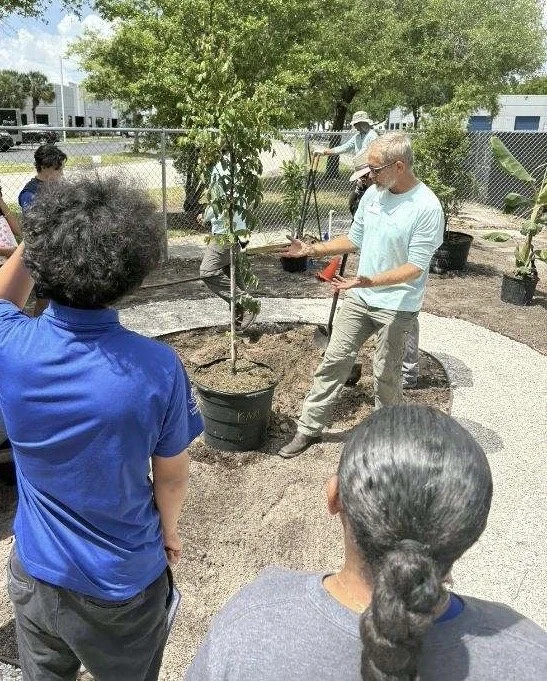
Trees are truly incredible plants that are essential to the health of our planet’s ecosystems and offer a myriad of benefits to us. While we generally recognize that trees are very important, we often don’t know many of the practical benefits for planting trees or which specific trees to plant in our own backyards. At Ecovision we routinely advise clients on tree planting and landscape designs, placing the right trees in the right places. Arbor Day and Earth Day is a great time to consider how trees improve our lives and the earth in tangible and positive ways.
Beauty and interest
First of all, trees add beauty and interest to our properties and homes. Structures without surrounding vegetation appear stark and alone. This may showcase exceptional architectural styles and large structures, but a standard single family home ‘needs’ vegetation around it to off-set the angular and flat spaces of the walls and roof. Trees soften and disrupt the lines and edges of a home creating an inviting and natural setting. Beyond pure aesthetics, well placed trees increase a home’s monetary value and can help a home sell faster. Studies have shown that homes with trees are valued up to 15% more than homes without, and homes with trees sell as much as three times faster. (money.com) We encourage you to observe the homes in your neighborhood. Notice the difference between homes with mature shade trees and homes that have few or no trees. How do the trees affect the overall feel and appearance of the property? How do the trees enhance or detract from the beauty of the home? Could you plant a tree that would enhance the value and beauty of your home?
Enhance wildlife biodiversity
Another way trees benefit us is by supporting local biodiversity. Our urban neighborhoods are increasingly deficient in bird and insect biodiversity, especially due to habitat loss from high density developments without adequate green spaces. Trees provide shelter for birds to nest, and protection from predators. The fruits and seeds of trees also provide food for birds and insects while the insects themselves become an important food source for birds and other critters. Fruit trees can also provide fruit for you and your family, or to share with friends. While some HOA restrictions prohibit planting fruit trees, we have had success working with various HOAs to get approval to plant many fruit trees throughout SWFL. Some fruit trees are sensitive to cold, which is another reason to begin with a good plan and careful species selection. In general, mango trees grow well in areas west of I-75, while more cold-hardy fruits like Avocado and Loquat are better choices for areas east of I-75. A practical way to support biodiversity in your neighborhood is to notice whether you have any fruit producing shrubs already growing in your landscape. If so, many of these shrubs are pruned so heavily that they rarely have the opportunity to flower and set fruit. Cocoplum and Simpson stopper are common examples of this. Consider allowing a frequently hedged cocoplum or Simpson Stopper in your landscape to grow larger and become a source of fruit for birds and critters in your neighborhood.
Shade for many benefits
A third and very cool way that trees benefit us and the environment is by providing shade. Most trees are highly effective at modifying their surrounding environment. By casting shade trees reduce soil and air temperature, and modify air flow and humidity beneath the canopy. Trees also change the characteristics of the soil around them through the build up of leaf litter and extensive root growth. In a backyard setting, we typically remove the leaves that fall from a tree for aesthetic reasons, but these leaves can provide an important source of organic matter which helps to maintain soil health. The understory beneath a shade tree is also a great opportunity for shade-loving plants to thrive. Once you establish a tree canopy, you will then have the opportunity to introduce a whole suite of shade-loving plants into that location. These plants will also benefit from the improved soil conditions in the shade zone of that tree. If you have a shade tree, consider allowing the leaves to accumulate under the tree. See how it changes what grows beneath that tree and consider introducing some new shade-loving plants over time. For Southwest Florida we suggest native ferns (Swamp fern or Sword Fern), Coontie, Native Canna, Native Iris, and Wild Coffee. A few edibles that thrive in shade include various gingers, Monstera deliciosa, aloe, and pineapple. The shade from trees can also have a significant impact on the energy cost of cooling a home. Placing trees on the western exposure of a home especially can shelter the home from afternoon heat. The USDA has estimated that a healthy shade tree can offer cooling equivalent to 10 small air conditioning units running 20 hours per day. The impact on energy bills can be as much as a 3% reduction in the first five years and up to a 12% reduction after 15 years.(Money.com)
Protection
Trees also help to protect us, our homes, and the rest of our landscape. Trees provide shelter from wind, reducing its impact on structures and other plants, while enhancing the comfort of a nearby space for sitting or gathering. Trees help reduce wind stress on more delicate plants in the landscape, protecting them from water loss through evapotranspiration. During the spring in SWFL, we experience a significant amount of moisture loss due to drying winds. This wind is removing moisture from the landscape and causing stress on many plants. When trees are planted strategically near sensitive plants or along property borders, the sheltered plants or crops are able to thrive and produce with less stress from drying wind. Some plants will set more fruit with shelter from wind. Starfruit (Carambola) is often planted commercially with wind breaks or constructed wind screens to prevent damage to the flowers. 12 Seasons farm, a local organic farm on Old Olga Road in Fort Myers has bamboo windbreaks planted on the borders as well as a native tree buffer zone along part of the property. These windbreaks provide shelter and protection from drying winds and cold air during the vegetable growing season. Their fruit trees also benefit from the shelter of the windbreaks, especially during strong summer storms and hurricanes. Consider the protected areas near trees in your yard and other landscapes, especially under the canopy and to the north. How do the conditions differ in the shelter and protection of those trees? What might you be able to grow there because of the presence of the tree?
Improved soil
Lastly, trees are amazing at holding soil in place and improving soil health over time. Few plants improve soil like trees. While grasses can produce large amounts of biomass and store carbon in the soil, trees are renowned for their ability to improve soil, promote healthy soil biology, and improve water infiltration. Tree roots penetrate deeper soil layers, providing channels and pathways for water to enter the soil and move down into aquifers. Trees also limit the impact of heavy rainfall on the soil, which can displace soil particles and cause erosion and gulley formation. Here in SWFL, mangroves are the first line of defence for our coastal areas, absorbing the impact of storm surge and wave action. Trees along stream banks and waterways help to stabilize the bank and prevent erosion. In our wetland areas, Cypress trees as well as Popash and Red Maple provide canopy and anchorage for many other native plants and wildlife. In your own yard, is there an area where erosion could be washing soil particles into a drainage swale or canal? This could be an opportunity to plant native trees or shrubs to stabilize the soil and prevent future loss of soil particles and nutrients into our local waterway or wetland.
Trees provide many tangible benefits to us and the environment around us. They make our homes more beautiful and valuable, feed us and the local wildlife, provide shade and cooling for our homes and landscapes, offer us protection from wind, and prevent erosion of our soil. We often take trees for granted, but this Arbor Day is a great opportunity to recognize and be grateful for the amazing gift of trees. Take the time to plant a tree this spring and enjoy the benefits for years to come, knowing that you, birds, bees and our entire community will benefit as well!
Resources:
Arbor Day Foundation: https://www.arborday.org/value
Nature Where We Live: https://www.audubonwe.org/services-6
IFAS - University of Florida Extension: https://gardeningsolutions.ifas.ufl.edu/care/planting/planting-and-establishing-trees/