

Mango Pruning in Southwest Florida for Fruit Production, Tree Health, and Storm Resilience
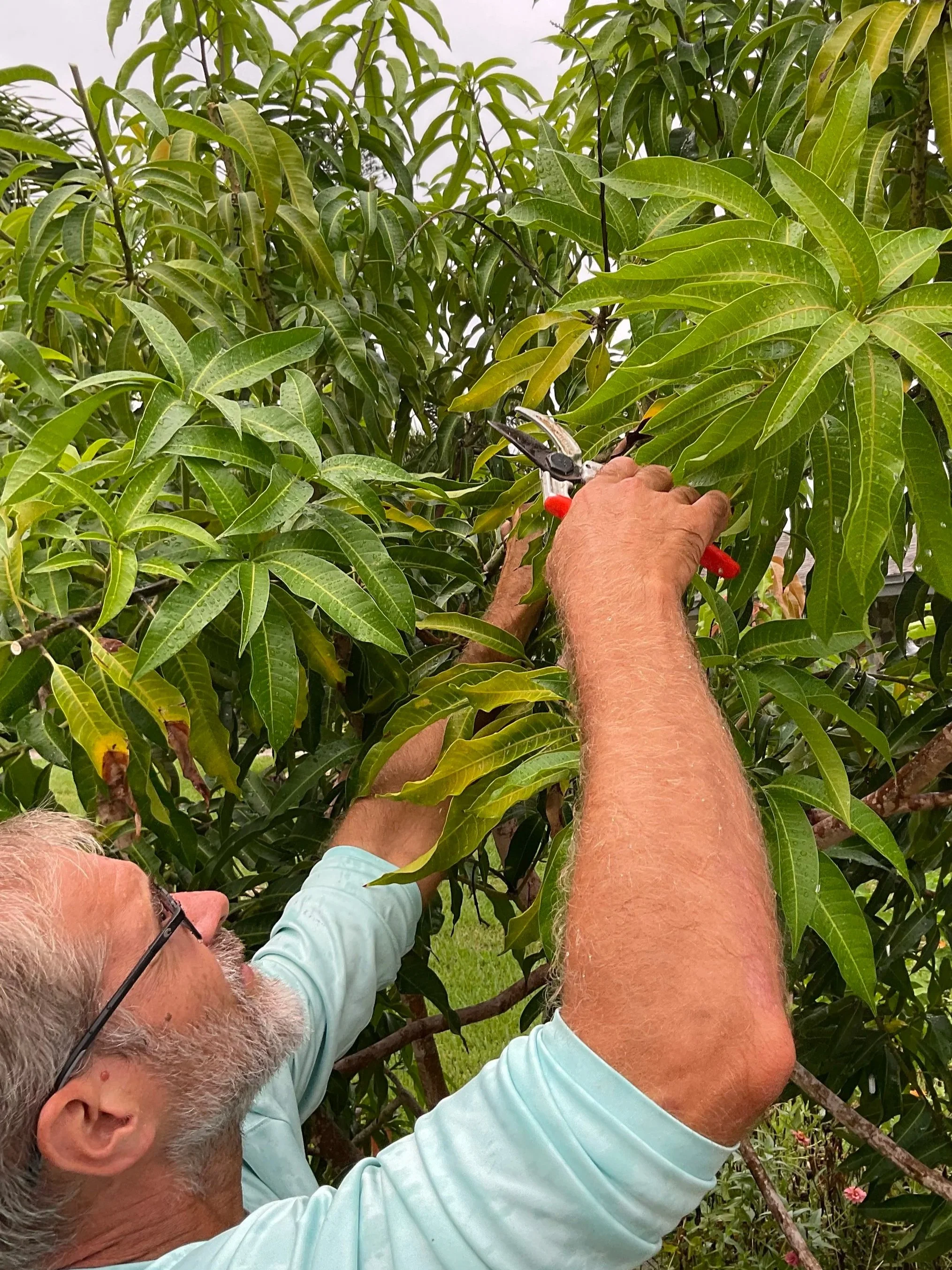
Pruning keeps a tree manageable and productive
Have you ever wondered how to get more mangoes from your tree while keeping the tree to a manageable size? These two goals seem mutually exclusive! But, with the correct pruning techniques you can control your tree size and improve fruit production at the same time. And here’s the good news: this is possible at any stage, whether your tree is young, mature, or overgrown. Pruning also makes harvesting easier, improves wind resistance, and reduces disease issues. Before we get into pruning techniques it is important to understand a few things about how a mango tree grows, what triggers flowering, and how the tree responds to pruning.
Mango tree growth habit and flowering
Mango trees alternate between vegetative growth (stems, leaves and roots) and reproductive growth (flowers and fruit). In SWFL, the colder, drier weather of winter triggers flowering and fruiting, while the warm temperatures and extra moisture of summer trigger leaf and stem growth. Regardless of the season, the trees are doing one activity at a time - either growing leaves or growing fruit.
Over time, a mango tree can become very large, especially an unmanaged tree or a seedling. Grafted trees are more manageable, but still grow to be large without regular pruning. While there are some mango varieties that have a dwarf growth habit, most mango varieties will eventually become a large tree and make harvesting fruit difficult. Large mango trees can also out-grow their space or become a risk for hurricane wind damage. So, despite how small a young mango tree may seem at first, it is destined to become a big tree. This means pruning is essential.
Another important characteristic of mango is that it bears from the terminals or branch tips. Increasing the number of terminals on the tree will increase the number of potential flowers and also fruit. So, pruning practices throughout the life of the tree should be aimed at increasing terminals to maximize fruit production. And here’s the beauty of it: this technique creates a highly branched and complex canopy resulting in a smaller and more compact tree form. Pruning to increase the fruit set also helps to control tree size!
Pruning Techniques
At Ecovision, we practice three basic pruning techniques with mango. The easiest and most important is tip pruning. The second is formation pruning, which is used to make selective cuts of larger limbs to improve tree shape and health. The last is a more radical approach to restore old or damaged trees to productivity and a manageable size.
Tip Pruning
Tip pruning mango is practiced from planting to create a highly branched canopy, then used throughout the tree’s life to maintain small tree size and continue to increase terminals. The goal of tip pruning is to generate more terminals by causing exponential branching within the canopy. Every cut of a terminal usually results in 3-5 new shoots emerging from that cut point. The total number of terminals that develop on the tree over repeated tip pruning will increase rapidly. A young tree may be tip pruned 2-3 times per year and will quickly develop a highly branched tree canopy. A side benefit of this pruning technique is that a young tree will flower sooner than a tree that is left unpruned.
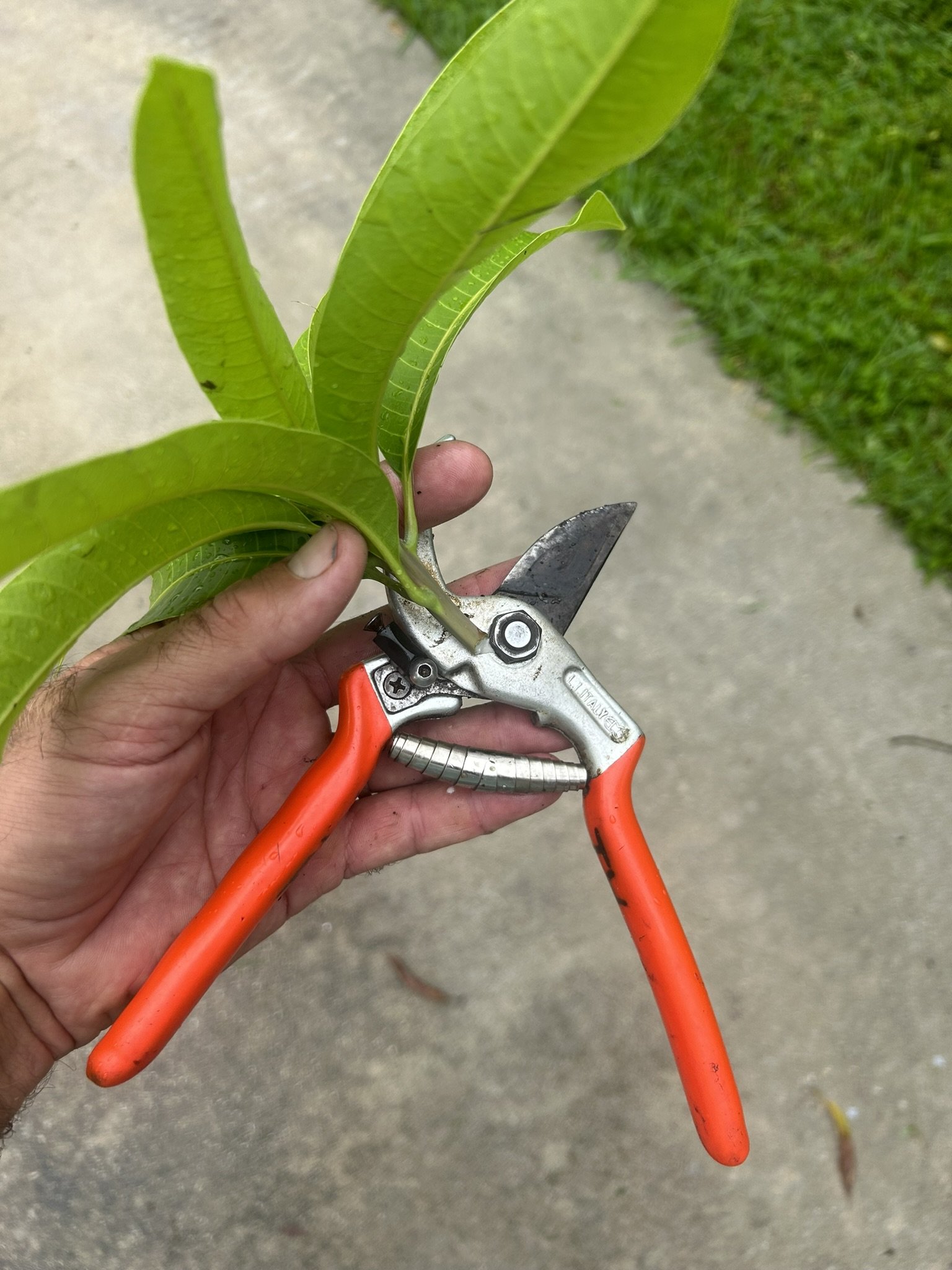
Tip pruning:
Remove just the tip of the branch with a pair of bypass clippers.
How:
Tip pruning is simple and easy to do. In fact it is meant to be fast and not require a lot of thought or careful cutting decisions, so that a grower can quickly prune many small trees in an orchard setting. The only tool required is a quality pair of sharp, clean bypass pruning shears. To prune a young tree, simply cut every branch tip or growth terminal. This removes a fair amount of the foliage on the tree but it will quickly replace it. Cuts should only be removing the branch tip, never thick stems or branches. Tipping removes only the ‘crown’ of the mango branch which is the end of a growth section.
When:
Tipping should be done once harvest is completed, but no later than August or early September in Florida. Pruning after September leads to a young flush on the tree during the winter cold season and a poor flowering response to the cold temperatures. It is critical to have a hardened flush of growth (4-5 months old) with mature, resting buds before the cool temperatures of December and January. These buds are ready for growth, but because of the cold, will be triggered to produce flowers rather than vegetative growth.
Sometimes tip pruning follows the more extensive rejuvenation pruning. This encourages branching and canopy development as the tree attempts to replace its branches and leaves. Without consistent tip pruning, a rejuvenated tree will favor vertical, vegetative growth and quickly become a large and unmanageable tree again.
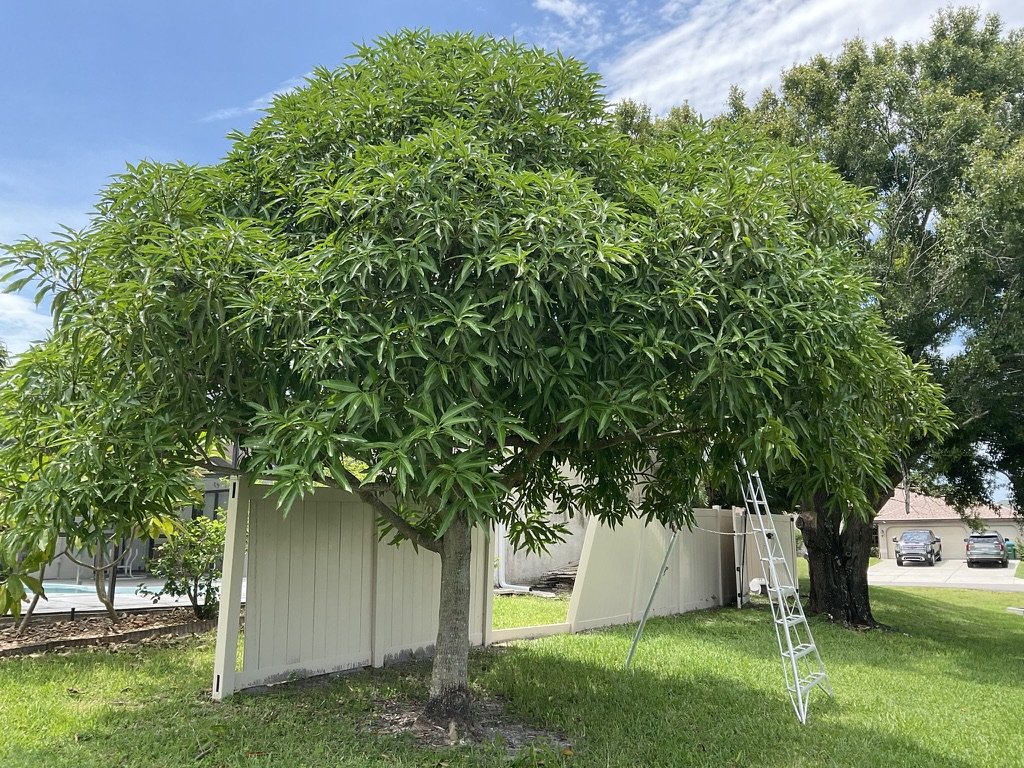
Mango tree before tip pruning.
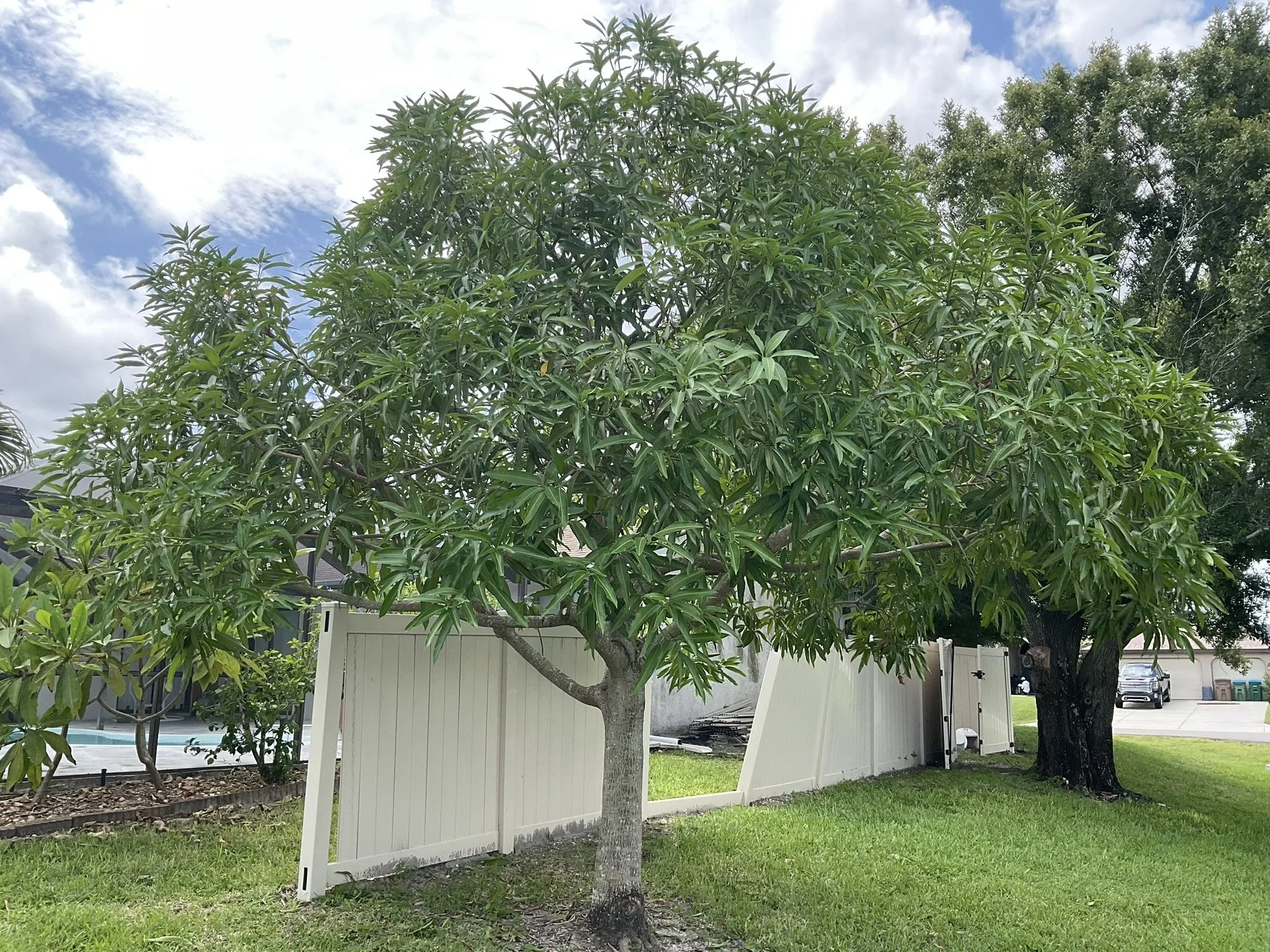
Mango tree after tip pruning.
Formation
This is the second tier of pruning that is primarily used to open up the canopy to increase light and air flow, as well as to remove overly vertical growth. The tree canopy can become too dense as the tree grows and matures, reducing air flow and light penetration. This can lead to a variety of issues. Reduced air flow can result in some disease and fruit quality issues (anthracnose especially), as well as increased chance of toppling or severe storm damage. A dense tree canopy can ‘catch’ the full force of strong winds making it vulnerable to major limb breakage or falling over entirely. A tree with a more open canopy will allow air to move through the canopy, limiting the force of the wind on the tree. Formation pruning is also important for removing crossing or overcrowded branches. This structural pruning should always be followed by tip pruning to control the tendency of the tree to produce vigorous regrowth in response to formation pruning.
How:
Formation pruning requires more skill and experience than tip pruning. First, carefully observe how various limbs may be cluttering or causing too much density in the center of the tree. Look for one or two limbs from the center of the tree that could be eliminated to allow more light and air into the canopy. These will be larger limbs that require careful pruning techniques to remove safely. Start by reducing the limb from high in the canopy and move toward the point where it attaches to the trunk or another larger limb. Remove the limb to the point of attachment and be sure not to damage the branch collar with the final cut. Depending on how cluttered the tree is, one or several limbs may need to be removed to sufficiently open up the center of the canopy. Any highly vertical limbs should also be removed to prevent the tree from continuing to move the canopy upward.
Once formation pruning has been done, the tree will respond with vigorous growth to replace the loss of several significant limbs. This may necessitate some additional pruning to keep this growth in check. Also, tip pruning should always be performed following any formation pruning to limit vigorous vegetative growth and encourage branching.
Rejuvenation
This is a radical approach to pruning that is used to reduce a large, overgrown and unmanageable tree to its major scaffold limbs and allow it to regenerate into a productive and manageable tree. This approach can also be used to restore storm damaged trees after hurricanes winds and severe limb injuries. But it is best for reducing tall and overgrown trees to a manageable height. Ideal timing is in the spring to maximize the growing season. The tree is ‘hat-racked’ down to the main scaffold limbs, ideally to a height of 10-12 feet. Because regrowth begins from the pruning cut, reducing the height as much as possible will have the greatest impact on the tree’s future height. Once pruning is completed, the trunk should be protected from sun exposure with white latex paint or layers of cut limbs (painting allows the best regrowth to occur, as branches can frustrate the new growth). Once significant regrowth has occurred (after several months) tip pruning should be used to promote branching and canopy development. This technique will dramatically reduce fruit production for the next one or two seasons, but the tree will recover quickly and begin to bear heavily within 2-3 seasons. Tip pruning should be performed several times during the two years following rejuvenation pruning. This will prevent the tree from stretching out and simply regaining its original size.
Rejuvenation pruning is not for the average home-owner. It often requires the help of an experienced arborist with the proper equipment. Many arborists may not be familiar with how a mango tree will respond to this type of pruning, so consider sharing this article and other helpful resources with your tree professional so that they understand the goal of rejuvenation pruning.
Conclusion
Mango is an amazing fruit that grows and produces well here in Southwest Florida. The trees, however, can become large and difficult to manage over time. Because of mango’s growth habit and flowering pattern, tip pruning is a valuable technique for developing a highly branched, complex canopy as well as encouraging early bearing. The practice of formation pruning is very helpful to maintain tree health and improve airflow through the canopy. In extreme situations, rejuvenation pruning can be used to restore an overgrown tree to productivity and a manageable size. Always remember to be careful when pruning and don’t hesitate to call a professional to get the job done safely!